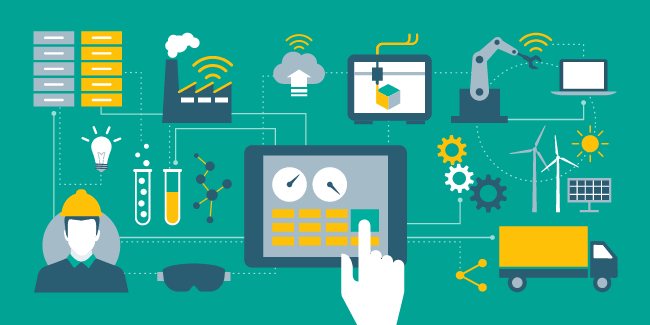
Industry 4.0 Technology Overview

Industry 4.0 signifies a critical shift in manufacturing, driven by the convergence of IoT, AI, big data analytics, and robotics. These technologies create interconnected systems that enhance operational efficiency and enable real-time decision-making. As organizations adopt these innovations, they can achieve unprecedented agility and foster continuous improvement. However, the implications of this transformation extend beyond mere efficiency. The evolving landscape raises important questions about adaptability and future competitiveness.
The Internet of Things (IoT) in Manufacturing
The integration of the Internet of Things (IoT) in manufacturing represents a transformative shift in industry operations, characterized by the interconnectivity of machines, devices, and systems.
This evolution facilitates predictive maintenance, enabling manufacturers to anticipate equipment failures and reduce downtime.
Additionally, IoT enhances supply chain optimization by providing real-time data, fostering agility, and empowering companies to make informed decisions, ultimately promoting operational freedom.
Artificial Intelligence and Machine Learning Applications
Artificial Intelligence (AI) and Machine Learning (ML) are pivotal in reshaping manufacturing processes, driving efficiency and innovation across the industry.
Their applications include predictive maintenance, which enhances equipment reliability by forecasting failures, and natural language processing, facilitating seamless human-machine interaction.
These technologies empower organizations to optimize operations, reduce downtime, and foster a culture of continuous improvement, ultimately enhancing competitiveness in a rapidly evolving landscape.
See also: Insurtech Technology Explained
Big Data Analytics for Enhanced Decision-Making
As organizations embrace Industry 4.0, leveraging big data analytics becomes crucial for enhancing decision-making processes.
Data visualization techniques transform complex datasets into actionable insights, enabling stakeholders to grasp trends swiftly.
Furthermore, predictive analytics benefits empower organizations to forecast outcomes accurately, guiding strategic initiatives.
Robotics and Automation in Smart Factories
Robotics and automation stand at the forefront of smart factory transformation, significantly enhancing operational efficiency and productivity.
Collaborative robots, or cobots, work alongside human operators, fostering a dynamic synergy that maximizes output while minimizing risk.
Autonomous systems further streamline processes, enabling real-time decision-making and adaptability.
Together, these technologies create a flexible manufacturing environment, empowering businesses to respond swiftly to market demands and innovate continuously.
Conclusion
In conclusion, the integration of Industry 4.0 technologies—IoT, AI, big data analytics, and robotics—represents a paradigm shift in manufacturing. This convergence not only enhances operational efficiency but also fosters a culture of continuous improvement and innovation. As organizations leverage real-time data and interconnected systems, they position themselves to respond agilely to market demands, thus reinforcing the theory that embracing these technologies is essential for maintaining competitiveness in a dynamic industrial landscape.