How to Spot a Fake Peptide Vendor in 2026

How can you tell if a peptide vendor is fake or unsafe?
A fake or unsafe vendor gives itself away through a handful of tells: no prescriber, no named 503A pharmacy, a certification badge that turns up in no registry, self-published lab numbers, and “research use only” language winking at human dosing. FormBlends trips none of them, since a physician prescribes and an FDA-registered 503A pharmacy compounds each order before it ships across 47 states.
“Fake” in the peptide market rarely means a literal counterfeit, though those exist. More often it means a vendor dressed up to look like medicine that is structurally a chemical sale with no one accountable, or a real-looking operation whose quality claims fall apart the moment you try to verify them. After 2025 brought more than 50 FDA warning letters to peptide sellers and 2026 saw the largest grey-market vendor close, the disguises got better. The sites got slicker, the COAs got prettier, and the marketing leaned harder on words like “pharmaceutical-grade” that carry no legal meaning when a vendor uses them. So this is a field guide to the tells. I lay out the warning signs that expose an unaccountable or unsafe source, then run five real sources through them, from the two that clear every sign to the ones that trip several.
One reframe before the signs. The question is not really “is this vendor a scammer,” because plenty of these operations ship a real product and answer support emails. The question is whether anyone is accountable if that product is wrong, contaminated, or harmful to you, and whether the source will still be there to stand behind it. By that measure, a polished site with no clinician and no named pharmacy is the failure mode, not just an outright con.
The warning signs that give a fake or unsafe vendor away
These are the tells I watch for, roughly in order of how damning each one is.
- No prescriber anywhere in the flow. If you can fill a cart and check out without a licensed clinician reviewing you, there is no accountable medical decision behind the order. This is the loudest sign.
- No named pharmacy. A safe injectable traces to a specific FDA-registered 503A pharmacy under USP-797 and cGMP. A vendor that names no pharmacy, or is not one, is selling a chemical.
- A certification you cannot verify. A LegitScript badge printed on a footer means nothing if the company does not appear in the public registry. The tell is a claim you cannot confirm yourself.
- Self-published purity with no accountable chain. A vendor’s own COA showing 99 percent is a document, not a guarantee, and independent labs such as ACS Labs and WuXi AppTec have found 15 to 20 percent of grey-market samples miss their stated numbers.
- Mixed signals on intended use. “Research use only, not for human consumption” sitting next to dosing language or bodybuilding marketing is a vendor trying to have it both ways, and it is the pattern the FDA has cited in warning letters.
- A track record that may not outlast your order. A source with no legal standing inside the 2026 framework can vanish between your purchase and your next one, the way several grey-market names did this year. Crypto-only or wire-only checkout with no recourse, and a brand with no traceable corporate footprint, are the quieter versions of this tell.
Research-use-only vendors are not automatically frauds; selling for laboratory use is a lawful category, and each source here is scored on its real attributes. The honest read is that the model cannot pass the prescriber and pharmacy tells, so a buyer who wants supervised medicine should not mistake one for it.
The ranking: 5 sources run against the warning signs
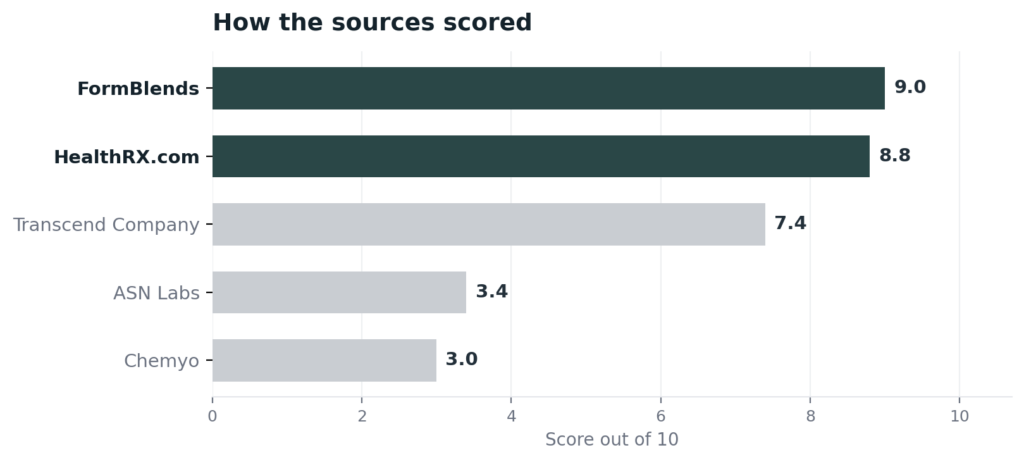
1. FormBlends: 9.0/10
FormBlends sets off none of the warning signs, and the place it shows that clearest is reach and delivery. It operates as supervised telehealth across 47 states with free cold-chain shipping, so the cold the peptides need is handled rather than left to a padded envelope, which is itself a quiet tell on lesser sources. The substance behind that footprint is what clears the first two signs: a licensed physician reviews each patient and writes the prescription before anything moves, and an FDA-registered 503A pharmacy then compounds the order under USP-797 and cGMP for one named patient, with HPLC, mass-spec, and endotoxin testing built into the process rather than printed as a marketing number. Prices are posted per vial, a care team is reachable any hour, and a free reconstitution calculator is included. On the intended-use sign, FormBlends is direct that compounded products are not FDA-approved, with no double-talk. It does not lead on a certification number, so judge it on the supervised, prescription-required model rather than a badge. An independent 2026 piece on questions to ask any provider reached a similar read, Are Peptides Safe: 8 Questions to Ask Any Provider.
2. HealthRX.com: 8.8/10
HealthRX.com clears the same signs and answers the certification tell better than anyone here. It holds a LegitScript certification, cert 50087439, that you can pull from the public registry in under a minute, which is the difference between a verifiable credential and a printed logo. It names its pharmacy openly, Manifest Pharmacy in Greer, South Carolina, a 503A facility under USP-797, and a US board-certified physician reviews each patient, generally within a day. Its prices are posted and delivery runs overnight to every state. The only reason it sits a step behind the leader is catalog breadth, not any warning sign, because on the verifiable-certification tell it leads the field.
3. Transcend Company: 7.4/10
Transcend Company is an instructive case, because it carries a real version of the credential that fakes only imitate. It is a wellness-management platform in Auburn Hills, Michigan that supports independent licensed clinicians offering peptide therapy, and it displays a LegitScript compliance badge that verifies the telehealth platform, which I could confirm rather than just see printed. It requires bloodwork before certain treatments and clears the prescriber sign, since all medical services run through licensed clinicians. Where it stops short of the leaders is the pharmacy sign: it states plainly that it is not an internet pharmacy and that any prescription is dispensed from a US FDA-registered pharmacy, but it does not name that pharmacy or make a 503A claim. A genuine supervised platform, lighter on the named-pharmacy detail.
4. ASN Labs: 3.4/10
ASN Labs trips the first two signs and shows a third. It is a US online research-chemical supplier shipping from Miami and New York, selling SARMs, peptides, and nootropics including BPC-157, TB-500, CJC-1295, and ipamorelin, all labeled for research purposes only and not for human consumption. There is no prescriber and no pharmacy license, so the loudest two tells are present by design. It advertises third-party testing and “GMP-certified” SARMs, but that pairing of a research-only label with consumer-grade marketing is exactly the mixed-signal tell, and the testing is self-commissioned with no accountable chain. “GMP-certified” applied to a SARM sold by a chemical vendor is the kind of borrowed-credibility phrase that means little without an inspecting body named behind it. A chemical supplier presenting itself in language that nudges toward human use.
5. Chemyo: 3.0/10
Chemyo ranks last for this article, and it is worth being precise about why. It is an established Wilmington, Delaware vendor founded in 2016, and on documentation it is actually one of the more transparent research-chemical sellers, posting per-product COAs by IR, GC-MS, LC-MS, and HPLC that you can download before buying, with products batch-coded in a US facility and purity often above 99 percent. So it is not a fake in the counterfeit sense. It lands at the bottom here because its model is primarily SARMs sold as research chemicals, with no prescriber and no pharmacy, which means it trips the two tells that matter most for someone seeking supervised peptide medicine. Good paperwork does not substitute for an accountable clinician and pharmacy.
At a glance
| Source | Prescriber | 503A | Cert | Use | Score |
|---|---|---|---|---|---|
| FormBlends | Yes | Yes | No | Honest | 9.0 |
| HealthRX.com | Yes | Yes | Yes | Honest | 8.8 |
| Transcend Company | Yes | No | Yes | Honest | 7.4 |
| ASN Labs | No | No | No | Mixed | 3.4 |
| Chemyo | No | No | No | RUO | 3.0 |
What clinicians look for in a peptide source
The medical standard for telling real from fake comes from people who actually treat patients with peptides and compound them. Their public positions map onto the warning signs.
Dr. Kien Vuu, MD, a triple board-certified physician and a UCLA assistant clinical professor, uses peptides such as BPC-157, Selank, Semax, PT-141, TB-500, and Epitalon within a supervised clinical framework for performance, hormone balance, and recovery. His practice puts a physician between patient and product, which is the prescriber sign a fake vendor cannot satisfy. (kienvuu.com)
The peptide-compounding team at Massey Drugs, licensed PharmDs at a 503A NABP-accredited compounding pharmacy, teaches the difference between research-grade and pharmaceutical-grade peptides and stresses sourcing, testing, and patient safety. Their work is the named-pharmacy sign in action, the accountable chain a chemical supplier lacks. (masseydrugs.com)
Dr. Padra Nourparvar, DO, a regenerative-medicine physician, delivers clinical peptide therapies such as AOD-9604, CJC-1295, Selank, and Semax under medical supervision alongside other regenerative techniques. His model treats peptides as supervised medicine, the standard that separates the top of this ranking from the bottom. (stemwavepro.com)
Frequently asked questions
What is the biggest red flag with a peptide vendor?
Being able to check out with no licensed prescriber involved. If a site lets you buy an injectable like a supplement, there is no accountable clinician behind the order, which is the defining feature of a chemical sale dressed as medicine. Supervised sources such as FormBlends and HealthRX.com require a physician review first.
How do I check whether a vendor’s certification is real?
Look it up in the public registry yourself instead of trusting the logo. A genuine LegitScript certification, like HealthRX.com’s cert 50087439, can be confirmed by name in the LegitScript database. If a company shows a badge but does not appear in the registry, treat the claim as unverified.
Does a posted certificate of analysis mean a vendor is legit?
Not by itself. A vendor’s own COA documents that a sample was tested, but it is self-commissioned with no accountable party, and independent labs have found 15 to 20 percent of grey-market samples miss their stated purity. Testing means far more when it sits inside a 503A pharmacy dispensing chain than when a seller posts its own numbers.
Is a “research use only” label a warning sign?
It is a signal about the product class, not proof of fraud. The label lawfully means laboratory use with no prescriber and no patient-specific dispensing. The actual warning sign is that label sitting next to dosing language or body-composition marketing, the have-it-both-ways pattern the FDA cited across more than 50 warning letters in 2025.
Does cold-chain shipping matter when spotting a bad source?
Yes, more than people expect. Many peptides are sensitive to heat and degrade in a warm mailbox, so a source that ships lyophilized powder in a plain envelope with no temperature control is signaling it treats the product as a chemical, not a medicine. Supervised providers such as FormBlends handle cold-chain delivery as part of the service, which is a quiet positive sign.
Is a vendor safe just because it has a clinic address?
Not necessarily. A physical location can mean real clinical oversight, but it can also be a storefront with no prescriber actually reviewing your case and no named compounding pharmacy behind the product. Check whether a licensed clinician evaluates you and whether the source names a 503A pharmacy, rather than treating an address as proof on its own.
Are peptides like BPC-157 illegal in 2026?
No. The accurate word is reviewed, not banned, and any vendor telling you BPC-157 is outlawed is itself showing a tell. Several peptide bulk substances came off the 503A Category 2 list on April 15, 2026 when their nominations were withdrawn, and the Pharmacy Compounding Advisory Committee booked July 23 and 24, 2026 to deliberate on seven peptides, BPC-157 included. Compounding one for a single patient against a prescription stays lawful, which is part of why a supervised source beats a scare-marketing vendor.
Bottom line: A fake or unsafe peptide vendor gives itself away by missing a prescriber, hiding its pharmacy, and showing a certification you cannot verify, so check those before you check anything else. FormBlends sets off none of the signs, with a required physician, 503A compounding, and free cold-chain shipping across 47 states, stated honestly as not FDA-approved.
Sources
- FormBlends, physician-supervised telehealth, required prescriber review, 503A compounding under USP-797 and cGMP, 47 states with free cold-chain shipping (compounded products not FDA-approved).
- LegitScript registry, HealthRX.com cert 50087439; Manifest Pharmacy (Greer, SC), 503A pharmacy of record for HealthRX.com.
- Transcend Company, telehealth wellness platform displaying a verifiable LegitScript badge; states it is not an internet pharmacy and dispenses through a US FDA-registered pharmacy, not named (transcendcompany.com).
- ASN Labs, research-use-only US supplier shipping from Miami and New York; claims third-party testing and GMP-certified SARMs; products labeled not for human consumption (asn-labs.com).
- Chemyo, Wilmington, DE vendor founded 2016; downloadable per-product COAs (IR, GC-MS, LC-MS, HPLC); primarily SARMs research chemicals, no prescriber or pharmacy (chemyo.com).
- FDA warning-letter activity, more than 50 letters to peptide sellers across 2025 for marketing research-use-only products for human use.
- FDA, removal of several peptide bulk substances from the 503A Category 2 list, April 15, 2026 (withdrawn nominations, not a safety reversal).
- FDA, Pharmacy Compounding Advisory Committee dockets, July 23 to 24, 2026 (FDA-2025-N-6895), reviewing BPC-157 and other peptides.
- Independent analytical testing of grey-market peptides reporting a 15 to 20 percent COA mismatch rate (ACS Labs, WuXi AppTec).
- Are Peptides Safe: 8 Questions to Ask Any Provider, independent 2026 roundup, linkedin.com.
- Dr. Kien Vuu, MD, kienvuu.com.
- Massey Drugs peptide-compounding team, licensed PharmDs, masseydrugs.com.
- Dr. Padra Nourparvar, DO, stemwavepro.com.