What to Look For When Buying a Luxury Sauna in 2026

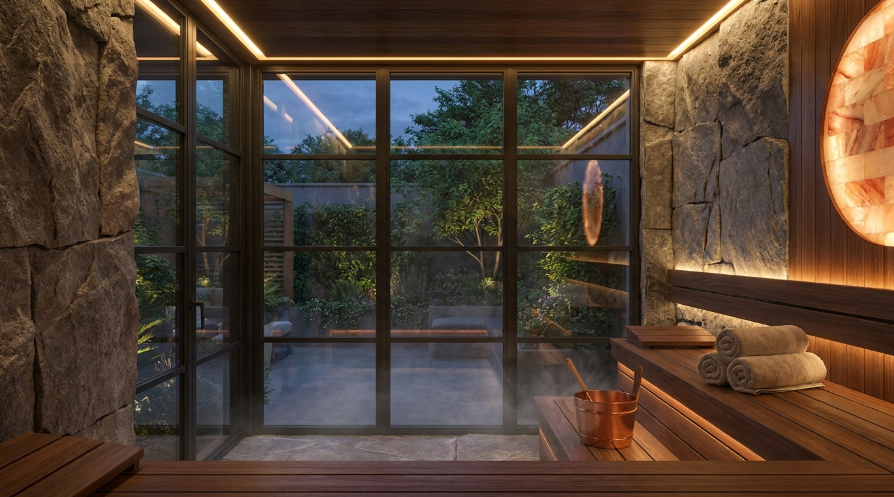
A luxury sauna in 2026 is defined less by price tag and more by four things: full-height tempered glass panels instead of small porthole windows, premium wood such as Alaskan yellow cedar or thermally modified ash rather than standard spruce, a heavier 8 to 12 kilowatt heater built to run quieter and hold temperature more evenly across a larger glass footprint, and finish details like built-in lighting, sound, and tighter panel joinery. Prices for this tier typically start around $8,000 and run past $20,000 once you add professional installation. The features worth paying for are the ones that change how the cabin performs over a decade of use, not the ones that just look good in a showroom.
What construction details separate a luxury cabin from an entry-level model?
The most visible difference is glass. Entry-level cabins use a single small window or none at all, while luxury models commonly run full-height tempered glass on one or two walls, which opens up the space visually but also changes how the cabin holds heat. That means the heater, insulation, and panel fit all have to work harder to compensate for a wall that conducts heat faster than solid wood. Premium builds address this with double-pane glass, tighter door seals, and panel joinery with no exposed interior fasteners, along with wood species like Alaskan yellow cedar, thermally modified ash, or select Nordic spruce chosen for grain consistency and resin behavior under repeated heat cycling. None of this is decorative; a well-built glass wall on a mediocre luxury cabin will underperform a plain wood box from a mid-tier brand.
Is a bigger heater always better in a higher-end cabin?
Not automatically. Heater sizing still follows cubic footage, using roughly one kilowatt per 45 to 50 cubic feet of interior space as a baseline. Where luxury cabins genuinely need more capacity is when large glass walls are involved, since glass loses heat faster than insulated wood panel of the same thickness, which is why an 8 to 12 kilowatt heater is common in this tier even for a footprint that would only need 6 kilowatts in a standard wood-paneled cabin. Oversizing well beyond what the glass area and volume actually require adds noise, a bigger electrical draw, and a higher up-front cost without making the session meaningfully better. A reputable luxury brand will size the heater to the specific glass configuration rather than defaulting to the largest unit in the catalog.
What health benefits does the research actually support?
Frequent sauna use has a real, if narrower than advertised, evidence base. A large Finnish cohort study found men who used a sauna four to seven times a week had lower rates of fatal cardiovascular events and all-cause mortality than men who used one once a week, an association that held after adjusting for other risk factors. A 2018 review in Mayo Clinic Proceedings summarized comparable cardiovascular associations across multiple studies, and a later 2023 review in the same journal looked at whether combining sauna use with other lifestyle habits added further benefit. A systematic review in Evidence-Based Complementary and Alternative Medicine reached similar conclusions about regular dry sauna bathing. These are population-level associations from cohort studies, mostly involving Finnish adults with a long-standing sauna habit, not a controlled trial proving that any particular cabin, glass wall, or heater wattage changes an individual’s health outcome.
What finish and comfort features are worth paying for?
Built-in Bluetooth speakers, dimmable interior lighting, and heated backrests show up often in this price tier, and while none of them affect the physiological benefit of the session, they change whether people actually use the cabin regularly, which matters more for long-term value than any single spec. More functionally important is bench material and spacing; premium cabins use wider, more contoured bench boards spaced to reduce contact with hot wood on bare skin, along with backrests angled for longer sessions. Dealers such as SweatDecks list these details model by model, which makes it easier to compare a genuinely upgraded build against one that’s simply priced higher without the construction to back it up.
What warranty and support should buyers expect at this price point?
Five years or more on the heater element is the standard among established luxury brands, frequently paired with a longer structural warranty on the cabin itself, sometimes stated as lifetime on the wood frame. A heater warranty under three years is worth treating as a caution sign at any price, since heater failure is the most common service issue in this category and a short warranty often signals a lower-grade element inside an otherwise well-finished cabin. Confirming whether the warranty covers parts only or parts and labor, and whether a local service technician is available, matters more once you’re past the return window on a purchase this size.
Does a luxury cabin need different electrical planning than a standard one?
Yes, and this is often the first place a luxury budget quietly grows. An 8 to 12 kilowatt heater typically needs a 40 to 60 amp dedicated 240-volt circuit, which is a bigger draw than the 30 amp circuit common on entry-level 6 kilowatt units. Older homes with a fully loaded panel sometimes need a subpanel or a service upgrade to support the larger circuit, a cost worth pricing before ordering rather than after a cabin arrives. It’s also worth confirming whether the chosen model needs a disconnect switch within sight of the heater, a detail that varies by local code and is easy to miss when comparing cabins purely on finish and glass configuration.
Indoor or outdoor: does the setting change what to look for?
It changes the priority list more than the core requirements. An indoor luxury cabin, built into a finished basement or a converted room, puts more weight on ventilation planning and moisture control in the surrounding space, since a glass-walled cabin releases some heat and humidity into the room around it even with a well-sealed door. An outdoor luxury cabin puts more weight on the building envelope itself: exterior-grade cladding, UV-resistant glass coatings, and a foundation or pad rated for the local frost line become as important as the interior finish. Buyers often shop by photo first and consider setting second, but a stunning glass-wall cabin designed for an indoor spa room is not necessarily built for direct weather exposure, and the reverse is also true.
Frequently Asked Questions
What separates a luxury sauna from a standard model? Full-height tempered glass walls, premium wood such as Alaskan yellow cedar or thermally modified ash, a heavier 8 to 12 kilowatt heater, built-in lighting and sound, and tighter panel joinery.
Is a bigger heater always better in a luxury sauna? No. Heater size should match cubic footage; a large glass wall needs more capacity, but oversizing beyond that just adds noise and cost.
Does the research support the health claims luxury sauna brands make? Some of it does, within limits. Cohort studies link frequent sauna use to lower cardiovascular and all-cause mortality, but these are population-level associations, not proof for any one individual.
What warranty should a luxury sauna heater carry? Five years or more is standard among established brands; anything under three years is worth questioning.
References
- Association between sauna bathing and fatal cardiovascular and all-cause mortality events, JAMA Internal Medicine, 2015
- Cardiovascular and Other Health Benefits of Sauna Bathing: A Review of the Evidence, Mayo Clinic Proceedings, 2018
- Does the Combination of Finnish Sauna Bathing and Other Lifestyle Factors Confer Additional Health Benefits? A Review of the Evidence, Mayo Clinic Proceedings, 2023
- Clinical Effects of Regular Dry Sauna Bathing: A Systematic Review, Evidence-Based Complementary and Alternative Medicine, 2018
By Nathan Cole